
The 90-Minute Radius
Germany's geography makes it easy to show up for Oktagon 88 Hannover. That might be the most complicated thing about it.
Germany's geography makes it easy to show up for Oktagon 88 Hannover. That might be the most complicated thing about it.
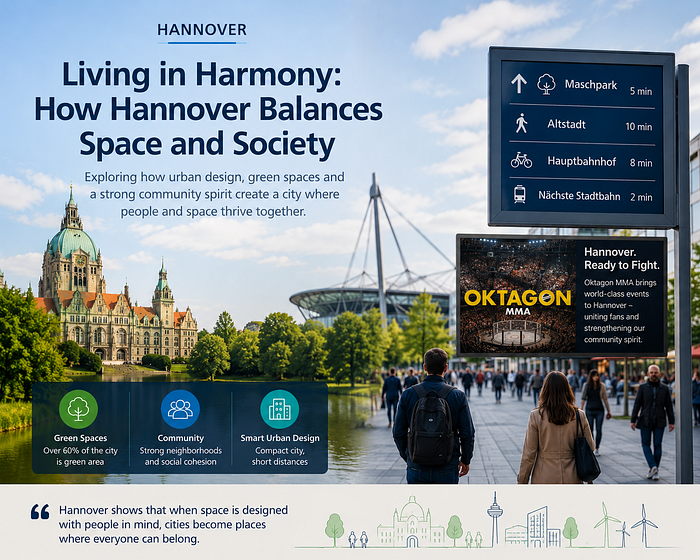
Where Hannover sits
Look at a map of northern Germany and draw a circle around Hannover. Ninety minutes by train or car. Inside that circle: Hamburg, reachable in under an hour; Bremen in 59 minutes on the fastest services; Bielefeld in 51 minutes; Dortmund in around 100 minutes. Several million people, all connected by rail running dozens of times a day.
This is not how most Oktagon markets work.
When Oktagon MMA brought its fight weekends to Liberec or Bratislava, the crowd had to commit. Crossing a border, booking a room, coordinating travel that doesn't run every fifteen minutes — these things filter fans before the event even begins. In Germany's north, that friction almost disappears.
When getting there costs you nothing, the decision to attend is a different kind of decision entirely.
The friction question
Here is what friction does that nobody talks about. It filters.
Fans who book trips to Oktagon fight weekends months in advance — arranging hotels near the arena, coordinating travel across a border, planning around the full card — those fans arrive already committed. The effort of planning is itself a signal. It says: this matters enough to absorb the inconvenience.
The Hannover crowd at Oktagon 88 on May 16 will contain people who decided this week. Some who decided yesterday. People who saw it in a feed and thought: that's actually close. Why not.
That is not a criticism. Those fans are real. Their money spends the same. Their noise inside the ZAG Arena — the biggest indoor venue in the Hannover region, opened in 2000, with a capacity above 10,000 — is just as loud. But they arrive at a different temperature. The anticipation hasn't been building for months. It's been building since Tuesday.
What this produces in the room
A convenience-driven crowd is harder to read from the outside. It tends to be bigger than expected, because the catchment area is genuinely vast. It also tends to be more mixed — people who came specifically for one fighter sitting next to people who came because a friend had a spare ticket and the train was under an hour.
That mix creates a particular kind of atmosphere. Louder in some moments than you'd anticipate. Quieter in others. Less collectively invested in the outcome, but individually capable of genuine passion when something connects.
This is Oktagon's second visit to Hannover — the first was Oktagon 75 in September 2025. Which means the promotion already has a baseline. The question isn't whether people will show up. It's whether the crowd that shows up Saturday looks more like a returning fanbase or a curiosity crowd doing a second lap.
Attendance tells you how many people showed up. It doesn't tell you why they came or whether they'll come back.
What expansion events actually measure
Fans planning fight weekend trips to Oktagon events in established cities tend to book earlier and stay longer than fans in newer markets. The planning behaviour changes when geography removes the need to plan. You don't book a hotel if you can leave at six and be home before midnight. You don't check the full card if you're going because a friend is going.
None of this shows up in a ticket count.
What it does show up in is the texture of the night. The way the arena builds or doesn't. Whether the crowd lifts a fight or just watches it. Whether people are still there in the closing bouts, or whether they started drifting toward the exits once the result they came for was settled.
Oktagon has built something real in Central Europe by earning crowds who chose them deliberately. The German market — Hamburg, Stuttgart, Düsseldorf, Hannover, and now Berlin coming in June — is a different test. Not harder, not easier. Just different.
The 90-minute radius brings the people in. What the data looks like after is the more interesting question.
Founder of Sport Event Planner — a platform helping Oktagon MMA fans plan fight weekend trips across Europe, from hotels near the arena to the full card ranked by the community.