
From Frankfurt to Friedrichshain: Oktagon's German Expansion Was a Map, Not a Tour
Oktagon's German expansion looks like ambition. Look closer and it reads like a map someone drew very carefully — fighter first, broadcaster second, venue as the reward for both.
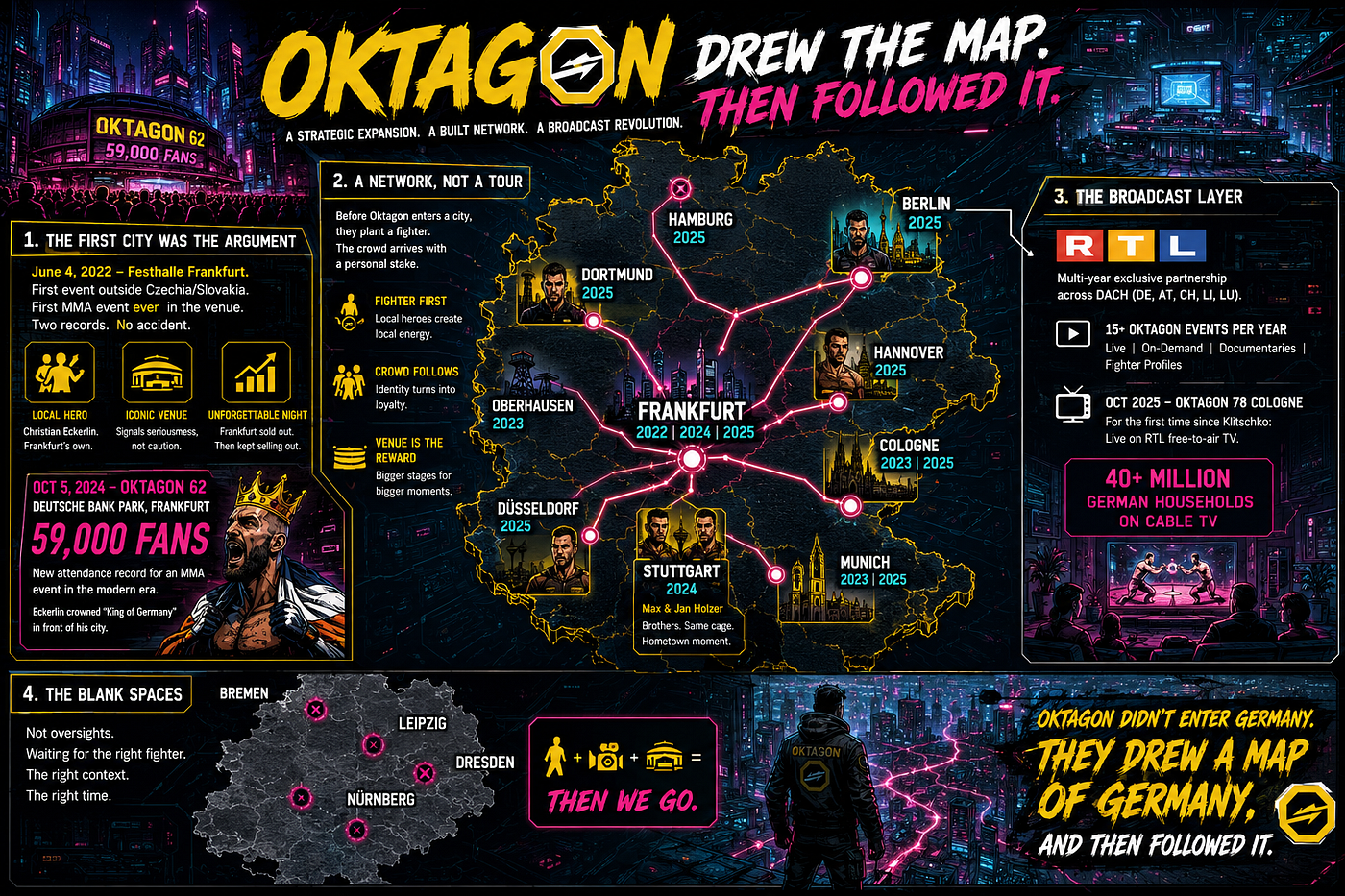
By Sport Event Planner Founder | June 2026
Originally published on Medium.
Oktagon's German expansion looks like ambition. Look closer and it reads like a map someone drew very carefully.
The First City Was the Argument
On June 4, 2022, Oktagon held its first event outside the Czech Republic and Slovakia. They chose Frankfurt.
Not Berlin. Not Munich. Not Cologne — a city with a deeper fight culture and a more obvious existing audience. Frankfurt. And the choice, at the time, was read mostly as circumstance. The Festhalle was available. Eckerlin was local. They gave it a try.
That reading misses what Frankfurt actually was. It was a proof of concept, not an experiment. The iconic Festhalle Frankfurt became the site of Oktagon 33 — the organisation's first-ever show across the Czech-Slovak border — on June 4, 2022, and also marked the first time MMA had ever been staged inside that venue. Two records broken simultaneously. One in sport. One in real estate. Neither accidental.
The logic was this: enter a city where you already have a fighter the crowd knows personally, book a venue that signals seriousness rather than caution, and make the first night impossible to ignore.
It worked. Frankfurt sold out. It kept selling out. By October 2024, Oktagon 62 at Deutsche Bank Park, home of Eintracht Frankfurt, set a new attendance record for an MMA event in the modern era — 59,000 fans, surpassing the UFC's biggest-attended show. Christian Eckerlin, Frankfurt-born, was crowned King of Germany in front of his own city. The crowd sang his walkout song before he reached the cage.
That night did not happen by accident either. It was the destination of a three-year journey that started with the decision to enter Germany through one specific door.
A Network, Not a Tour
What followed Frankfurt was not a rollout. It was a sequence with internal logic.
Oberhausen in 2023. Munich that same year. Cologne. Stuttgart. Then in 2025: Düsseldorf, Dortmund, Hamburg, Frankfurt again, Cologne again, and Munich again — seven German cities in a single year, representing half of Oktagon's entire 2025 event calendar. Each city paired with fighters who could carry local weight. Kerim Engizek from Düsseldorf. The Holzer brothers — Max and Jan — from the Stuttgart region, stepping into the same cage together at Oktagon 88 in Hannover for the first time in history, in front of their hometown crowd.
The pattern is consistent enough to be a policy. Before Oktagon enters a city, it has already embedded a fighter in that city's identity. The crowd does not arrive neutral. It arrives with a personal stake in the outcome.
This is not how most promotions approach expansion. Most chase the biggest available venue in the most populous market and hope the event fills the room. Oktagon builds toward the room. The fighter comes first. The crowd follows the fighter. The venue is the reward for both.
The Broadcaster Layer
Underneath the city-by-city logic sits a second structure that makes it all commercially coherent.
In late 2024, Oktagon signed a multi-year exclusive media partnership with RTL Germany covering the DACH region — Germany, Austria, Switzerland, Liechtenstein, and Luxembourg — with RTL's platforms streaming more than 15 Oktagon events per year, alongside documentaries and fighter profiles.
That deal reframes the entire German map. Events in Düsseldorf, Stuttgart, or Hannover are not just local fight nights. They are content production for a streaming platform with national reach. Every new city adds a local fighter story, a local crowd reaction, a regional audience segment that RTL can serve. The geographic spread is also an audience-building strategy.
In October 2025, Oktagon 78 in Cologne went further: for the first time since the Klitschko brothers dominated boxing, a combat sport was broadcast live on German free-to-air television — the main card airing on RTL itself, not just the streaming platform.
That is a different order of reach. RTL's cable household base is estimated at upwards of 40 million German homes. The streaming subscriber base, however impressive, is a fraction of that. Cologne was not just another event. It was the moment Oktagon entered living rooms that had never searched for a fight card in their lives.
The Blank Spaces
Look at the full confirmed list of German cities: Frankfurt, Oberhausen, Munich, Cologne, Stuttgart, Düsseldorf, Dortmund, Hamburg, Hannover, and now Berlin.
Notice what is not there.
Leipzig. Dresden. Nuremberg. Bremen. Cities with real populations, real arena infrastructure, and no Oktagon date yet. The blank spaces are not oversights. They are the cities where Oktagon has not yet found the fighter who makes the first night work. Or the broadcaster context that justifies the cost. Or both.
The expansion is not moving across Germany. It is moving through Germany along specific lines — the RTL broadcast corridor, the local-hero network, the venue tier that signals ambition without overextending.
Berlin fits all three criteria. The Uber Arena holds 17,000 for MMA, and Oktagon's own framing positions it as a new city for a new audience, while promising the same electrifying atmosphere that has filled sold-out arenas in Czechia, Slovakia, and Germany. The card carries Kasim Aras as the local heavyweight challenger, Alina Dalaslan as Germany's most compelling women's fighter, and Niko Samsonidse — all fighters with existing Berlin threads.
The blank cities will come. But only when the conditions that made Frankfurt work in 2022 can be replicated there.
Oktagon did not enter Germany. They drew a map of Germany, and then followed it.
Sources: OktagonMMA.com, MMA UK, MMA News, RDX Sports, Uber Arena, Berlin.de.